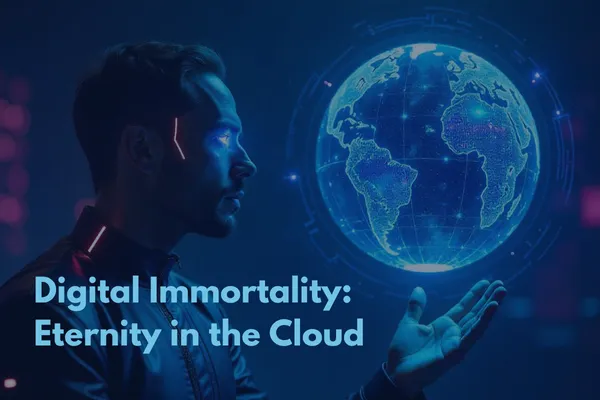
Digital Immortality-Are We Ready for a Post-Biological Future?
In a world racing toward radical technological convergence, the idea of digital immortality is shifting from science fiction to scientific consideration. The latest episode of Cognitive Code, hosted by Dr. Marcus Chen and Dr. Amara Okafor, dives into this controversial topic. What happens when our consciousness, memories, and sense of ourselves can be preserved beyond our biological lifespan?
Defining the Spectrum of Digital Immortality
Digital immortality isn’t a monolithic concept. It spans a spectrum from passive digital remains (social media profiles, text, videos) to interactive AI simulations, and ultimately to theoretical constructs like whole brain emulation. In the near-term, chatbots like Replika can simulate personality traits based on digital footprints, raising questions about identity persistence and the illusion of continuity.
But the far end of this trajectory involves mind uploading, transferring human consciousness into a digital substrate. It’s an idea that challenges everything we know about memory, identity, and ourselves.
Consciousness: Simulation or Continuity?
A major philosophical divide centers on whether a digitally replicated mind is you or merely a functional simulation. Dr. Marcus Chen points to Locke’s theory of psychological continuity;
"If memory is retained, perhaps identity is preserved."
However, Dr. Okafor reminds us that subjective experience or qualia remains the uncracked core of the "hard problem of consciousness."
The question remains: Even if we can digitally preserve neural connections, can we replicate the experience of being human?
Referenced Assertion:
The Allen Institute’s 2023 synaptic-level map of a mouse brain is a significant leap in neural mapping, highlights progress, but with humans’ 100 billion neurons, scalability remains a formidable challenge.
Ethics, Equity, and the Political Economy of Immortality
Even if technical hurdles are overcome, the societal implications are profound.
Access: A 2022 Journal of Medical Ethics paper by Dr. Sarah Richardson warns that life-extending technologies could exacerbate inequality, creating a two-tier system of digital haves and have-nots.
Agency and Ownership: If a digital copy of yourself persists post-mortem, who controls it? Can it be deleted? Modified? Sold? The absence of legal frameworks around digital personhood leaves this space dangerously undefined.
Environmental Cost: A study in Environmental Research Letters notes that maintaining even 1% of humanity as digital minds would exceed current global energy output, barring advances in energy-efficient computing.
Cultural & Religious Conflict: Diverse belief systems offer varied views on life, death, and the soul. Some, like the Christian Transhumanist Association, see potential alignment; others view digital immortality as philosophically or theologically incompatible.
Human Values in a Post-Biological Context
Technologists and ethicists agree on one thing: any move toward digital immortality must be guided not just by feasibility, but by desirability. What kind of digital existence is worth pursuing? Will autonomy, self-determination, and psychological continuity be preserved?
The hosts conclude with the provocative idea of the Ship of Theseus, gradually replacing biological neurons with artificial ones to achieve continuity without abrupt transition. But even this concept is still in the realm of speculative neuroscience.
Conclusion
In the end, the march toward digital immortality is not inevitable, but it is increasingly plausible. As technologies in brain-computer interfacing, neural mapping, and AI evolve, we are confronted with urgent questions about identity, control, equity, and what it means to be alive.
Would you choose to live forever in digital form?
What rights should digital selves have?
What kind of world are we building when death is no longer the endpoint?

